

農藝學系-U31-E01農作物永續生產模組(全英語)(開始施行114-2)
| 領域模組名稱 | ||||||||||||
| 中文 | 農作物永續生產模組 | |||||||||||
| 英文 | Module of Sustainable Crop Production | |||||||||||
| 領域模組預計開始施行時間 | 114學年度第2學期 | |||||||||||
| 主責教學單位 | 農藝學系 | 召集人 | 陳建德 | |||||||||
| 學習目標與預期學習效益 | 本模組將提供全英文的課程,其目標在培養可參與國際永續農業發展的菁英。因此,特別安排階段式學習模組如下 This module will be offered in English with the aim of educating exceptional students who can contribute to the development of international sustainable agriculture. Therefore, the step learning modules are specially arranged as follows 1. 建立作物生產的基本概念: 本課程旨在讓學生對作物生產有一個基本的瞭解。該課程涵蓋農業的重要性和發展、作物起源和分類、作物分佈和生產趨勢、農業生態學、作物生產系統、作物與水的關係、土壤和植物營養、作物種子和播種、根系、莖和葉、光合作用和呼吸、開花和繁殖、作物改良、氣候和天氣對作物的影響、 有害生物及其控制、植物病害和管理、雜草和雜草控制、植物生長調節劑、作物產量和品質、生產技術以及與作物生產相關的可持續農業概念。該課程提供作物栽培的基本培訓,並為更高級的學習奠定基礎。 核心競爭力: 學生將獲得有關如何通過栽培實踐和遺傳改良來管理作物產量和品質的專業知識,並有能力應對與可持續農業生產相關的挑戰。 1. Establish basic concepts for crop production:
This course is designed to provide students with a basic understanding of crop production. The course covers the importance and development of agriculture, crop origin and classification, crop distribution and production trends, agroecology, crop production systems, crop-water relationship, soil and plant nutrition, crop seeds and sowing, root system, stems and leaves, photosynthesis and respiration, flowering and propagation, crop improvement, climate and weather effects on crops, pests and their control, plant diseases and management, weed and weed control, plant growth regulators, crop yield and quality, production technology and sustainable agriculture concepts related to crop production. The course offers basic training in crop cultivation, laying a foundation for further advanced learning.
Core Competitiveness: Students will gain expertise in how to manage crop yield and quality through cultivation practices and genetic improvement, and will be equipped to address the challenges associated with sustainable agricultural production.
2. 導入永續作物生產模式及所需的進階知識 該課程為學生導入永續作物生產的模式概述,透過實作重點介紹植物營養的基本原理及其在作物栽培和土壤肥力管理中的應用。通過土壤養分供應、肥料施用和植物養分吸收等主題,學生將全面瞭解如何永續地支援作物生長。另讓學生由生物統計與遺傳育種,擇一修習進階知識,以瞭解永續農業發展的未來趨勢。 核心競爭力: 學生將獲得與永續農業發展相關的基本知識和實踐技能,包括應用植物營養原理和栽培技術來提高作物生產力的能力,同時支援長期的農業環境永續性。 2. Introduce sustainable crop production models and the advanced knowledge required
The course introduces students to a comprehensive model of sustainable crop production, focusing on the fundamental principles of plant nutrition and their application in crop cultivation and soil fertility management through practical exercises. Through topics such as soil nutrient supply, fertilizer application, and plant nutrient uptake, students will gain a comprehensive understanding of how to support crop growth in a sustainable manner. In addition, students are allowed to choose between biostatistics and genetic breeding to study advanced knowledge and understand future trends in sustainable agriculture development.
Core Competitiveness:
Students will gain essential knowledge and practical skills related to sustainable agriculture development, including the ability to apply plant nutrition principles and cultivation techniques to enhance crop productivity while supporting long-term agricultural environmental sustainability.
3. 永續農業的施行 該高級課程著重於永續農業技術的實際應用,加深學生對國際農業、精準農業和農業廢棄物利用中的的理解。本課程融合了演講、實作、田間採樣和專家講座。通過這項培訓,學生將培養管理永續作物生產系統的技術技能,並深入瞭解國際不斷發展的農業的趨勢和工作力需求。該課程還探討了國家凈零農業政策、生物資訊與國際行銷的理論和技術基礎以及其價值和工業效益評估等關鍵主題。 核心競爭力: 學生將獲得應用永續農業技術的實用技能,以及評估有助於環境可持續性的作物生產和管理策略的能力。 3. Implementation of sustainable agriculture This advanced course focuses on the practical application of sustainable farming techniques, deepening students' understanding of international agriculture, precision agriculture, and the utilization of agricultural waste. This course is a blend of presentation, hands-on, field sampling, and expert lectures. Through this training, students will develop technical skills in managing sustainable crop production systems and gain a deep understanding of the evolving trends and workforce needs in international agriculture. The course also explores key topics, including national net-zero agriculture policies, the theoretical and technical foundations of bioinformatics, and international marketing, as well as their value and industrial benefit assessment. Core Competitiveness: Students will gain practical skills in applying sustainable farming techniques, as well as the ability to evaluate crop production and management strategies that contribute to environmental sustainability. |
|||||||||||
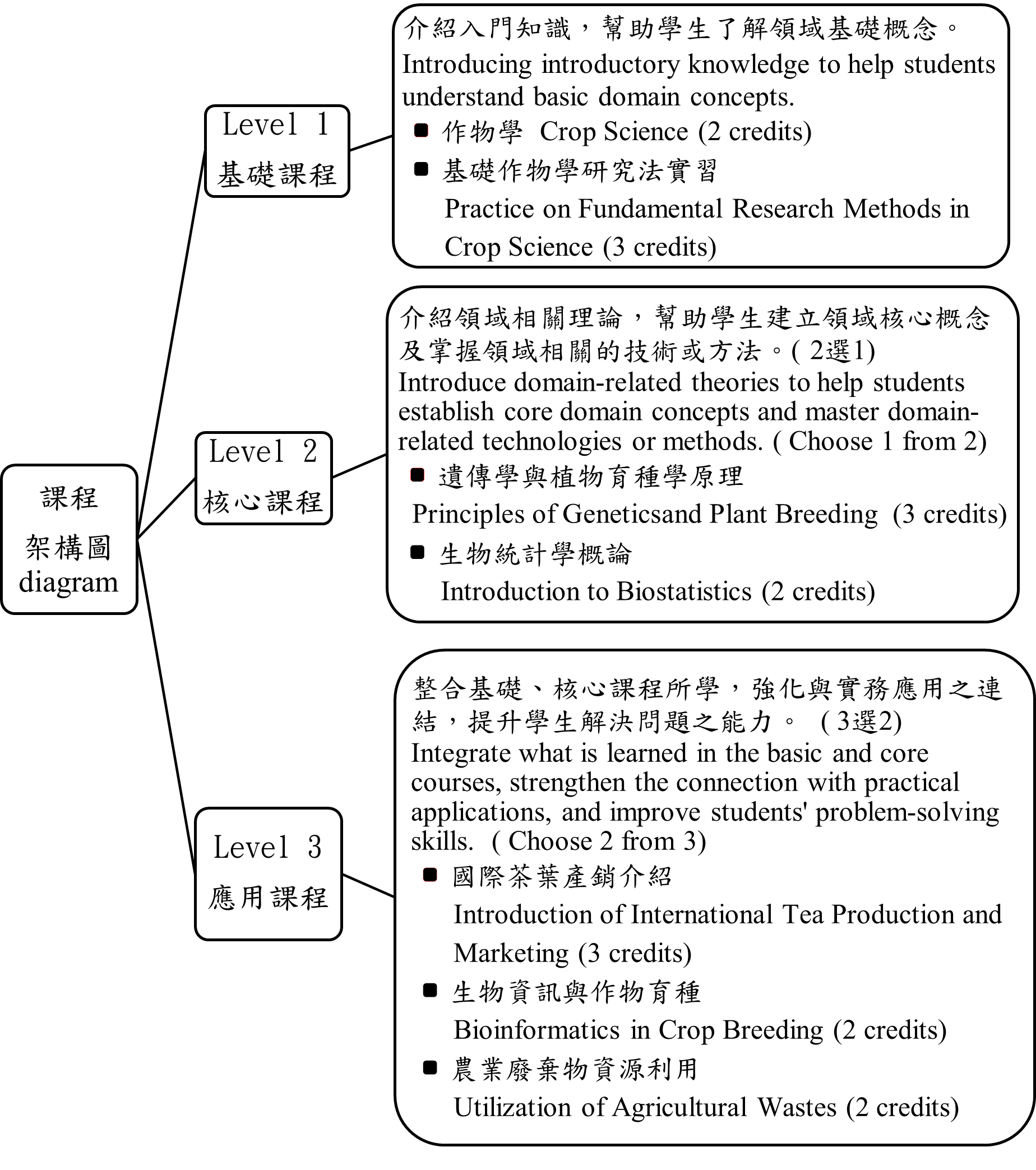
| 課程架構圖 Curriculum architecture diagram |
 |
|||||||||||
| 修課指引 course guidelines |
1.本領域必選Required in this field ●作物學 Crop science (2 credits), ●基礎作物學研究法Practice on Fundamental Research Methods in Crop Science (3 credits) 另從下列核心課程選1課程 In addition, choose 1 course from the following core courses ●遺傳學與植物育種原理 Principles of Genetics and Plant Breeding (3 credits) ●生物統計學概論 Introduction to Biostatistics (2 credits) 然後從下列應用課程選2課程 Finally, Choose 2 courses from the following application courses ●國際茶葉產銷介紹 Introduction of International Tea Production and Marketing (3 credits) ●生物資訊與作物育種 Bioinformatics in Crop Breeding (2 credits) ●農業廢棄物與資源利用Utilization of Agricultural Wastes (2 credits) 2.應用課程簡介 ●國際茶葉產銷介紹 本課程通過介紹茶葉生產、茶道和全球茶葉市場的現狀,為學生提供國際茶葉行銷的基本知識。 ●生物資訊與作物育種 本課程介紹生物資訊及其工具的演變。此外,鼓勵學生熟悉成熟的應用程式。 ●農業廢棄物資源利用 本課程探討農業廢棄物用於生物質能源和肥料,涵蓋氣化、液化和生物炭應用等技術。學生在專家指導下參與動手實驗、小組討論和項目規劃生物炭生產。評估基於參與、反饋和個人學習反思,而不是傳統的考試。 Introduction to the application course ●Introduction to International Tea Production and Marketing This course provides students with a basic understanding of international tea marketing by introducing the production of tea, tea ceremonies, and the current state of the global tea market. ●Bioinformatics in Crop Breeding This course introduces the evolution of bioinformatics and its tools. In addition, students are encouraged to familiarize themselves with mature applications. ●Utilization of Agricultural Wastes This course explores the use of agricultural waste for biomass energy and fertilizers, covering techniques such as gasification, liquefaction, and biochar applications. Students engage in hands-on experiments, group discussions, and project planning for biochar production under the guidance of experts. Assessments are based on engagement, feedback, and personal learning reflection rather than traditional exams. 職業導向設計: 可持續作物生產模組的設計以職業為導向,為學生提供作物生產和可持續農業實踐方面的全面培訓。綜合課程——包括基礎、核心和應用課程,如作物科學、作物科學基礎研究方法實踐、遺傳學和植物育種原理、生物統計學導論、國際茶葉生產和營銷導論、作物育種中的生物資訊學和農業廢棄物的利用。可為學生準備不同的職業道路如下: 永續農業專家: 該課程為學生提供作物種植和可持續農業技術方面的實用知識和技能,使他們能夠管理田間作業、進行現場採樣和實施碳減排的農業實踐。 土壤碳管理專家: 學生在土壤肥力管理方面獲得了堅實的理論基礎, 瞭解土壤特性和功能在作物生產力和可持續生態系統中的作用。為配合全球凈零碳目標和臺灣的農業轉型,該模組培養碳農業和可持續土地管理的未來專業人士。 研發人員: 通過農業政策和碳中和戰略方面的高級培訓,學生為在農業研究機構、大學和生物安全機構中的角色做好了充分準備。此外,該模組還支持國內和國際農業投入品公司的人才發展,培養整個農業部門的跨學科專業知識. Career-oriented design: The Sustainable Crop Production module is designed to be career-oriented, providing students with comprehensive training in crop production and sustainable farming practices. Comprehensive Curriculum – Includes basic, core, and applied courses such as crop science, basic research methods practice in crop science, principles of genetics and plant breeding, introduction to biostatistics, introduction to international tea production and marketing, bioinformatics in crop breeding, and use of agricultural waste. Different career paths that can be prepared for students are as follows: Sustainable Agriculture Experts: The course equips students with practical knowledge and skills in crop cultivation and sustainable farming techniques, enabling them to manage field operations, conduct field sampling, and implement carbon-reducing agricultural practices. Soil Carbon Management Expert: Students gain a solid theoretical foundation in soil fertility management, understanding the role of soil properties and functions in crop productivity and sustainable ecosystems. In line with the global net-zero carbon goal and Taiwan's agricultural transition, this module nurtures future professionals in carbon agriculture and sustainable land management. R&D personnel: Through advanced training in agricultural policy and carbon neutrality strategies, students are well-prepared for roles in agricultural research institutions, universities, and biosafety institutions. Additionally, the module supports talent development for national and international agricultural input companies, fostering interdisciplinary expertise across the agricultural sector. |
|||||||||||
| 課程規劃內容如下 | ||||||||||||
| 課程名稱 | 規劃要點(附註) | 開課單位 | 備註 | |||||||||
| 1 | 2 | 3 | 4 | 5 | 6 | |||||||
| (中文)作物學 | U | A | R | S | 2 | 1 | 國農企學程 | |||||
| (英文)Crop science | ||||||||||||
| (中文)基礎作物學研究法實習 | U | B | R | S | 3 | 1 | 農藝學系 | |||||
| (英文)Practice on Fundamental Research Methods in Crop Science | ||||||||||||
| (中文)生物統計學概論 | U | A | E | S | 2 | 2 | 農藝學系 | 2選1 | ||||
| (英文)Introduction to Biostatistics | ||||||||||||
| (中文)遺傳學與植物育種學原理 | U | A | E | S | 3 | 2 | 農藝學系 | |||||
| (英文)Principles of Genetics and Plant Breeding | ||||||||||||
| (中文)國際茶葉產銷介紹 | U | A | E | S | 3 | 3 | 生管學程 | 3選2 | ||||
| (英文)Introduction of International Tea Production and Marketing | ||||||||||||
| (中文)農業廢棄物資源利用 | U | A | E | S | 2 | 3 | 農藝學系 | |||||
| (英文)Utilization of Agricultural Wastes | ||||||||||||
| (中文)生物資訊與作物育種 | U | A | E | S | 2 | 3 | 農藝學系 | |||||
| (英文)Bioinformatics in Crop Breeding | ||||||||||||
| 取得認證需修習總課程數 | 5 | 取得認證需修習總學分數 | 11-13 | |||||||||